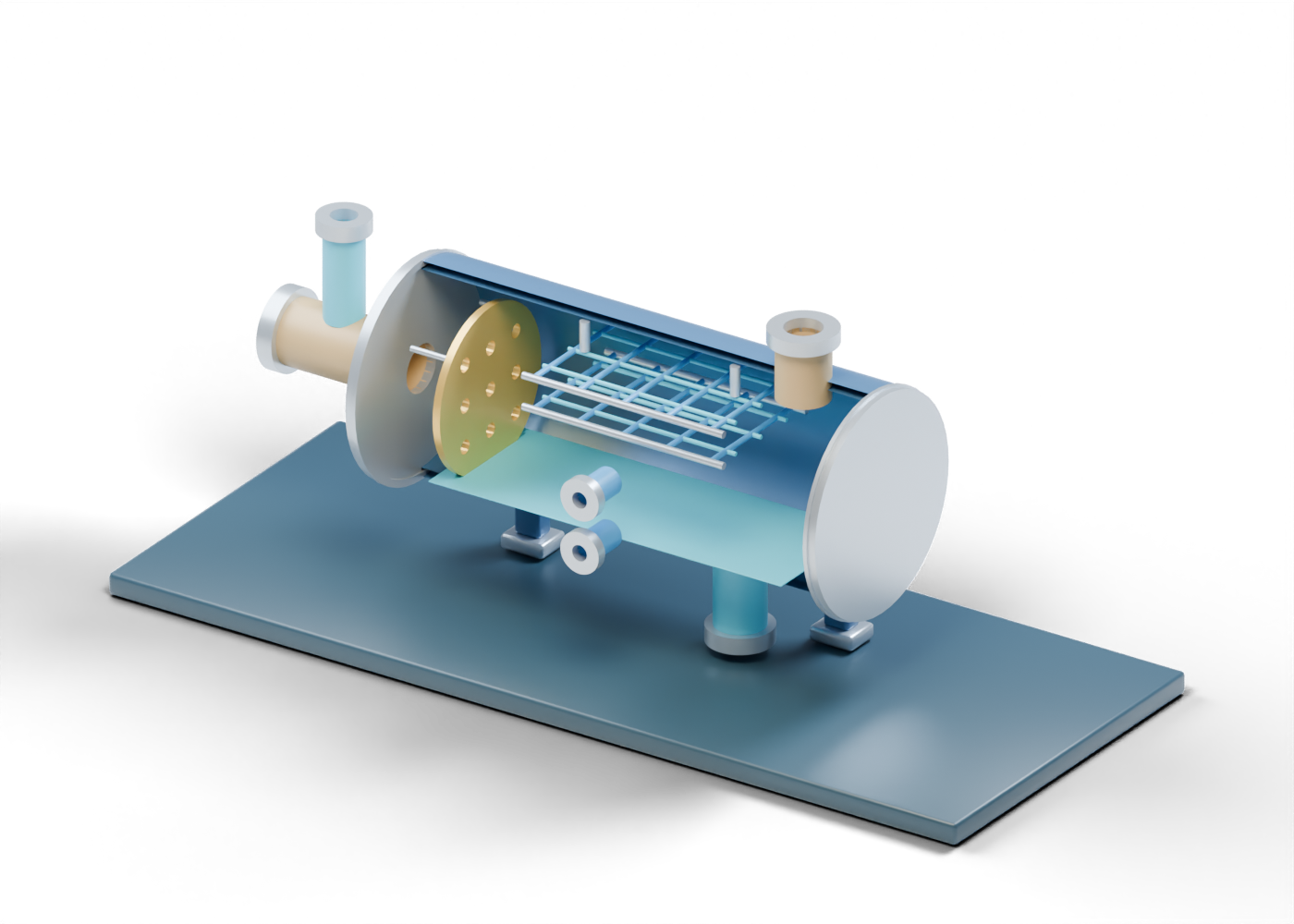
Desalter presentation plinth
Display base, not a foundation. Invented static teaching geometry. No selected crude, salt load, wash-water quality, emulsion, voltage, pressure, temperature, residence time, controls, treatment or safe access is specified.
Complete crude-desalter vessel wall
Complete double-surface horizontal enclosure with five separate side passages. Invented static teaching geometry. No selected crude, salt load, wash-water quality, emulsion, voltage, pressure, temperature, residence time, controls, treatment or safe access is specified.
Bored feed-side vessel closure
End closure with one real crude-feed passage. Invented static teaching geometry. No selected crude, salt load, wash-water quality, emulsion, voltage, pressure, temperature, residence time, controls, treatment or safe access is specified.
Closed treated-side vessel closure
Static closed end; no selected pressure-vessel head form. Invented static teaching geometry. No selected crude, salt load, wash-water quality, emulsion, voltage, pressure, temperature, residence time, controls, treatment or safe access is specified.
Feed-side seam marker
Visible enclosure junction, not a weld detail. Invented static teaching geometry. No selected crude, salt load, wash-water quality, emulsion, voltage, pressure, temperature, residence time, controls, treatment or safe access is specified.
Treated-side seam marker
Visible enclosure junction, not a weld detail. Invented static teaching geometry. No selected crude, salt load, wash-water quality, emulsion, voltage, pressure, temperature, residence time, controls, treatment or safe access is specified.
Mixed-crude feed hollow neck
Open incoming crude boundary meeting the bored end closure. Invented static teaching geometry. No selected crude, salt load, wash-water quality, emulsion, voltage, pressure, temperature, residence time, controls, treatment or safe access is specified.
Mixed-crude feed open collar
Open arrival marker without a rated connection. Invented static teaching geometry. No selected crude, salt load, wash-water quality, emulsion, voltage, pressure, temperature, residence time, controls, treatment or safe access is specified.
Wash-water branch hollow neck
Open water boundary at an actual feed-line opening; no selected water quality or mixing device. Invented static teaching geometry. No selected crude, salt load, wash-water quality, emulsion, voltage, pressure, temperature, residence time, controls, treatment or safe access is specified.
Wash-water branch open collar
Open wash-water connection marker. Invented static teaching geometry. No selected crude, salt load, wash-water quality, emulsion, voltage, pressure, temperature, residence time, controls, treatment or safe access is specified.
Separate mix-location marker
A location cue after water meets crude; no mixing valve, shear rate or emulsion result is depicted. Invented static teaching geometry. No selected crude, salt load, wash-water quality, emulsion, voltage, pressure, temperature, residence time, controls, treatment or safe access is specified.
Treated-crude exit hollow neck
Open upper crude boundary, not an outlet-quality result. Invented static teaching geometry. No selected crude, salt load, wash-water quality, emulsion, voltage, pressure, temperature, residence time, controls, treatment or safe access is specified.
Treated-crude exit open collar
Separate open marker without a downstream distillation unit. Invented static teaching geometry. No selected crude, salt load, wash-water quality, emulsion, voltage, pressure, temperature, residence time, controls, treatment or safe access is specified.
Desalter-water exit hollow neck
Separate lower water boundary; treatment is outside this scene. Invented static teaching geometry. No selected crude, salt load, wash-water quality, emulsion, voltage, pressure, temperature, residence time, controls, treatment or safe access is specified.
Desalter-water exit open collar
Open water-handling destination marker. Invented static teaching geometry. No selected crude, salt load, wash-water quality, emulsion, voltage, pressure, temperature, residence time, controls, treatment or safe access is specified.
Nine-hole inlet distributor marker
Separate invented entry-region plate with nine real holes; no distribution or separation result. Invented static teaching geometry. No selected crude, salt load, wash-water quality, emulsion, voltage, pressure, temperature, residence time, controls, treatment or safe access is specified.
Distributor stand-off -0.52
Static location tie, without attachment design. Invented static teaching geometry. No selected crude, salt load, wash-water quality, emulsion, voltage, pressure, temperature, residence time, controls, treatment or safe access is specified.
Distributor stand-off 0.52
Static location tie, without attachment design. Invented static teaching geometry. No selected crude, salt load, wash-water quality, emulsion, voltage, pressure, temperature, residence time, controls, treatment or safe access is specified.
Electrode region 1 long perimeter -0.62
Open neutral lattice boundary; no electrode spacing, voltage or field calculation. Invented static teaching geometry. No selected crude, salt load, wash-water quality, emulsion, voltage, pressure, temperature, residence time, controls, treatment or safe access is specified.
Electrode region 1 long perimeter 0.62
Open neutral lattice boundary; no electrode spacing, voltage or field calculation. Invented static teaching geometry. No selected crude, salt load, wash-water quality, emulsion, voltage, pressure, temperature, residence time, controls, treatment or safe access is specified.
Electrode region 1 cross member 1
Independent open rod, not a vendor electrode profile or energized component. Invented static teaching geometry. No selected crude, salt load, wash-water quality, emulsion, voltage, pressure, temperature, residence time, controls, treatment or safe access is specified.
Electrode region 1 cross member 2
Independent open rod, not a vendor electrode profile or energized component. Invented static teaching geometry. No selected crude, salt load, wash-water quality, emulsion, voltage, pressure, temperature, residence time, controls, treatment or safe access is specified.
Electrode region 1 cross member 3
Independent open rod, not a vendor electrode profile or energized component. Invented static teaching geometry. No selected crude, salt load, wash-water quality, emulsion, voltage, pressure, temperature, residence time, controls, treatment or safe access is specified.
Electrode region 1 cross member 4
Independent open rod, not a vendor electrode profile or energized component. Invented static teaching geometry. No selected crude, salt load, wash-water quality, emulsion, voltage, pressure, temperature, residence time, controls, treatment or safe access is specified.
Electrode region 1 cross member 5
Independent open rod, not a vendor electrode profile or energized component. Invented static teaching geometry. No selected crude, salt load, wash-water quality, emulsion, voltage, pressure, temperature, residence time, controls, treatment or safe access is specified.
Electrode region 1 longitudinal member 1
Independent open rod; no field strength or capture performance. Invented static teaching geometry. No selected crude, salt load, wash-water quality, emulsion, voltage, pressure, temperature, residence time, controls, treatment or safe access is specified.
Electrode region 1 longitudinal member 2
Independent open rod; no field strength or capture performance. Invented static teaching geometry. No selected crude, salt load, wash-water quality, emulsion, voltage, pressure, temperature, residence time, controls, treatment or safe access is specified.
Electrode region 1 longitudinal member 3
Independent open rod; no field strength or capture performance. Invented static teaching geometry. No selected crude, salt load, wash-water quality, emulsion, voltage, pressure, temperature, residence time, controls, treatment or safe access is specified.
Electrode region 2 long perimeter -0.62
Open neutral lattice boundary; no electrode spacing, voltage or field calculation. Invented static teaching geometry. No selected crude, salt load, wash-water quality, emulsion, voltage, pressure, temperature, residence time, controls, treatment or safe access is specified.
Electrode region 2 long perimeter 0.62
Open neutral lattice boundary; no electrode spacing, voltage or field calculation. Invented static teaching geometry. No selected crude, salt load, wash-water quality, emulsion, voltage, pressure, temperature, residence time, controls, treatment or safe access is specified.
Electrode region 2 cross member 1
Independent open rod, not a vendor electrode profile or energized component. Invented static teaching geometry. No selected crude, salt load, wash-water quality, emulsion, voltage, pressure, temperature, residence time, controls, treatment or safe access is specified.
Electrode region 2 cross member 2
Independent open rod, not a vendor electrode profile or energized component. Invented static teaching geometry. No selected crude, salt load, wash-water quality, emulsion, voltage, pressure, temperature, residence time, controls, treatment or safe access is specified.
Electrode region 2 cross member 3
Independent open rod, not a vendor electrode profile or energized component. Invented static teaching geometry. No selected crude, salt load, wash-water quality, emulsion, voltage, pressure, temperature, residence time, controls, treatment or safe access is specified.
Electrode region 2 cross member 4
Independent open rod, not a vendor electrode profile or energized component. Invented static teaching geometry. No selected crude, salt load, wash-water quality, emulsion, voltage, pressure, temperature, residence time, controls, treatment or safe access is specified.
Electrode region 2 cross member 5
Independent open rod, not a vendor electrode profile or energized component. Invented static teaching geometry. No selected crude, salt load, wash-water quality, emulsion, voltage, pressure, temperature, residence time, controls, treatment or safe access is specified.
Electrode region 2 longitudinal member 1
Independent open rod; no field strength or capture performance. Invented static teaching geometry. No selected crude, salt load, wash-water quality, emulsion, voltage, pressure, temperature, residence time, controls, treatment or safe access is specified.
Electrode region 2 longitudinal member 2
Independent open rod; no field strength or capture performance. Invented static teaching geometry. No selected crude, salt load, wash-water quality, emulsion, voltage, pressure, temperature, residence time, controls, treatment or safe access is specified.
Electrode region 2 longitudinal member 3
Independent open rod; no field strength or capture performance. Invented static teaching geometry. No selected crude, salt load, wash-water quality, emulsion, voltage, pressure, temperature, residence time, controls, treatment or safe access is specified.
Unelectrified lattice support marker 1
Placement cue only; no electrical penetration, insulation or attachment design. Invented static teaching geometry. No selected crude, salt load, wash-water quality, emulsion, voltage, pressure, temperature, residence time, controls, treatment or safe access is specified.
Unelectrified lattice support marker 2
Placement cue only; no electrical penetration, insulation or attachment design. Invented static teaching geometry. No selected crude, salt load, wash-water quality, emulsion, voltage, pressure, temperature, residence time, controls, treatment or safe access is specified.
Static desalter-water region plane
Arbitrary blue location marker, not an interface level or volume. Invented static teaching geometry. No selected crude, salt load, wash-water quality, emulsion, voltage, pressure, temperature, residence time, controls, treatment or safe access is specified.
Upper observation hollow neck
Open observation location only; no probe, alarm, controller or setpoint. Invented static teaching geometry. No selected crude, salt load, wash-water quality, emulsion, voltage, pressure, temperature, residence time, controls, treatment or safe access is specified.
Upper observation open collar
Uninstrumented open marker. Invented static teaching geometry. No selected crude, salt load, wash-water quality, emulsion, voltage, pressure, temperature, residence time, controls, treatment or safe access is specified.
Lower observation hollow neck
Open observation location only; no probe, alarm, controller or setpoint. Invented static teaching geometry. No selected crude, salt load, wash-water quality, emulsion, voltage, pressure, temperature, residence time, controls, treatment or safe access is specified.
Lower observation open collar
Uninstrumented open marker. Invented static teaching geometry. No selected crude, salt load, wash-water quality, emulsion, voltage, pressure, temperature, residence time, controls, treatment or safe access is specified.
Closed desalter inspection neck
Side opening with a separately closed cover; no vessel-entry guidance. Invented static teaching geometry. No selected crude, salt load, wash-water quality, emulsion, voltage, pressure, temperature, residence time, controls, treatment or safe access is specified.
Desalter inspection cover seat
Annular location cue, not a gasket specification. Invented static teaching geometry. No selected crude, salt load, wash-water quality, emulsion, voltage, pressure, temperature, residence time, controls, treatment or safe access is specified.
Closed desalter inspection cover
Static closed cover without a maintenance procedure. Invented static teaching geometry. No selected crude, salt load, wash-water quality, emulsion, voltage, pressure, temperature, residence time, controls, treatment or safe access is specified.
Desalter support stand 1
Illustrative contact to the vessel wall, not a load or foundation design. Invented static teaching geometry. No selected crude, salt load, wash-water quality, emulsion, voltage, pressure, temperature, residence time, controls, treatment or safe access is specified.
Desalter bored support foot 1
Independent foot with a real anchor opening. Invented static teaching geometry. No selected crude, salt load, wash-water quality, emulsion, voltage, pressure, temperature, residence time, controls, treatment or safe access is specified.
Desalter support stand 2
Illustrative contact to the vessel wall, not a load or foundation design. Invented static teaching geometry. No selected crude, salt load, wash-water quality, emulsion, voltage, pressure, temperature, residence time, controls, treatment or safe access is specified.
Desalter bored support foot 2
Independent foot with a real anchor opening. Invented static teaching geometry. No selected crude, salt load, wash-water quality, emulsion, voltage, pressure, temperature, residence time, controls, treatment or safe access is specified.
Desalter support stand 3
Illustrative contact to the vessel wall, not a load or foundation design. Invented static teaching geometry. No selected crude, salt load, wash-water quality, emulsion, voltage, pressure, temperature, residence time, controls, treatment or safe access is specified.
Desalter bored support foot 3
Independent foot with a real anchor opening. Invented static teaching geometry. No selected crude, salt load, wash-water quality, emulsion, voltage, pressure, temperature, residence time, controls, treatment or safe access is specified.
Desalter support stand 4
Illustrative contact to the vessel wall, not a load or foundation design. Invented static teaching geometry. No selected crude, salt load, wash-water quality, emulsion, voltage, pressure, temperature, residence time, controls, treatment or safe access is specified.
Desalter bored support foot 4
Independent foot with a real anchor opening. Invented static teaching geometry. No selected crude, salt load, wash-water quality, emulsion, voltage, pressure, temperature, residence time, controls, treatment or safe access is specified.